
The Quiet Powerhouses: Japan’s Small and Medium Manufacturers
What Global Buyers Should Know
Japan is globally known for industrial giants and world-leading brands. Companies like Toyota, Sony, and Honda dominate headlines when we talk about Japanese manufacturing.
However, behind these global corporations lies a powerful network that rarely receives the spotlight: Japan’s small and medium manufacturing enterprises (SMEs).
These businesses form the backbone of the country’s industrial ecosystem. Quietly, consistently, and with extraordinary precision, they manufacture components, tools, materials, and technologies that power industries around the world.
For global buyers and manufacturers, understanding this ecosystem opens the door to some of the most reliable and high-quality suppliers in the world.
The Backbone of Japanese Industry
In Japan, SMEs are not a side story — they are the industrial foundation.
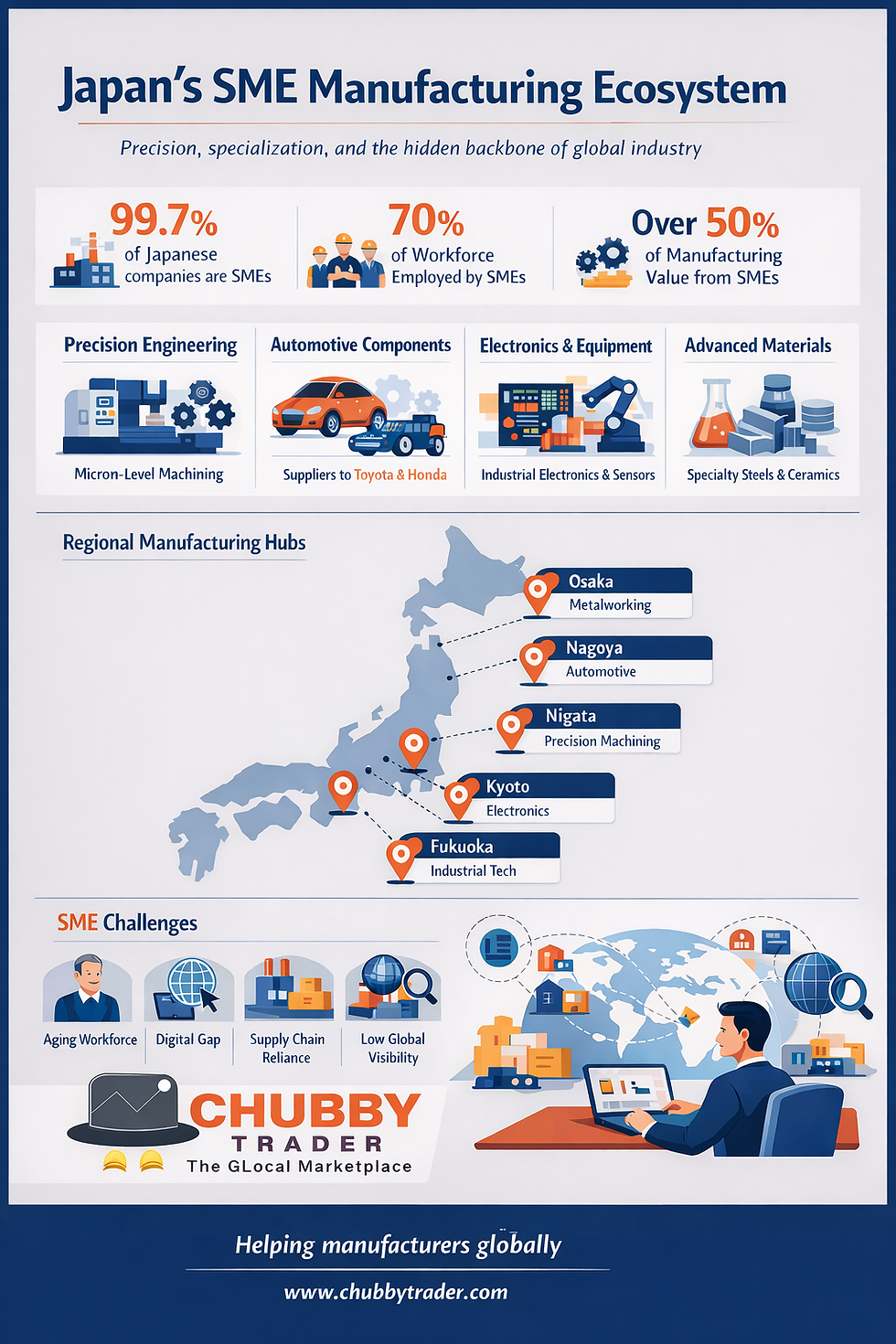
99.7% of companies in Japan are SMEs
They employ roughly 70% of the workforce
They contribute more than half of Japan’s manufacturing output
Many of these companies are family-owned businesses that have operated for decades, sometimes even generations. Over time, they have developed deep expertise in extremely specialized manufacturing processes.
While large corporations focus on global brand presence and final products, SMEs focus on precision, components, and specialized industrial capabilities.
Masters of Precision Manufacturing
Japanese SME manufacturers are globally respected for their engineering discipline and manufacturing quality.
Typical specialties include:
Precision machining: Small factories producing micron-level parts used in automotive, aerospace, and robotics.
Industrial components: Bearings, motors, sensors, connectors, and electronic parts used across global supply chains.
Advanced materialsSpecialty steels, ceramics, chemicals, and composites.
High-precision toolingMolds, dies, and cutting tools used in advanced manufacturing.
Many of these companies dominate extremely niche global markets — sometimes producing components that very few companies worldwide can manufacture at the same quality level.
Regional Manufacturing Clusters
Japan’s SME manufacturing ecosystem thrives in regional industrial clusters where skills, suppliers, and technologies evolve together.
Some well-known regions include:
Osaka – Metalworking and precision tooling
Nagoya (Aichi Prefecture) – Automotive supply chain manufacturing
Niigata – Precision machining and metal processing
Kyoto – Electronics and scientific instruments
Fukuoka – Machinery and industrial equipment
These clusters create tightly integrated supply chains where small manufacturers collaborate with larger industrial groups, forming a resilient manufacturing ecosystem.
The Philosophy Behind Japanese Manufacturing Quality
One of the defining characteristics of Japanese manufacturing is the philosophy of continuous improvement, often known as Kaizen.
This approach focuses on:
Eliminating waste
Improving efficiency step by step
Maintaining strict quality control
Empowering workers to improve processes
The result is manufacturing environments where precision, discipline, and consistency are deeply embedded into everyday operations.
For buyers, this translates into exceptionally reliable suppliers.
Challenges Facing Japanese Manufacturing SMEs
Despite their technical excellence, many Japanese SME manufacturers face structural challenges.
Aging workforce
Many SME owners are now over 60 years old. A significant number of businesses face succession challenges as younger generations pursue different careers.
Limited digital presence
Many companies still rely on traditional networks and domestic relationships. As a result:
English-language marketing is limited
Online product catalogs are often minimal
Global buyers may struggle to discover these manufacturers
Dependence on domestic supply chains
A large number of SMEs primarily serve major Japanese corporations rather than international customers.
This creates an opportunity for greater global exposure.
A Hidden Opportunity for Global Buyers
For international buyers, Japan’s SME manufacturing sector represents an under discovered opportunity.
These companies offer:
World-class precision manufacturing
Decades of technical experience
Highly reliable production standards
Consistent quality and delivery
Yet many remain largely invisible in global B2B discovery channels.
As supply chains evolve and companies diversify sourcing beyond traditional hubs, discovering these manufacturers becomes increasingly valuable.
The Role of Digital Platforms in Global Manufacturing Discovery
The global manufacturing landscape is becoming more connected every year. Buyers now expect faster supplier discovery, transparent capabilities, and direct communication with manufacturers.
This is where platforms like ChubbyTrader play an important role.
ChubbyTrader is designed to help manufacturers and suppliers increase their global visibility, connect with international buyers, and showcase their capabilities through modern digital tools.
By making it easier for buyers to discover manufacturers across regions, the platform helps bridge the gap between highly capable producers and global demand.
Looking Ahead
Japan’s small and medium manufacturing enterprises may not always make global headlines, but they remain one of the most sophisticated industrial ecosystems in the world.
Their strengths — precision engineering, disciplined production, and deep specialization — continue to support global industries.
As the world moves toward more diversified and transparent supply chains, these quiet powerhouses may finally receive the international visibility they deserve.
Are you a manufacturer looking to reach global buyers?
Create your free Trader account on ChubbyTrader and showcase your manufacturing capabilities to the world: https://www.chubbytrader.com/trader-limited-offer


Comments